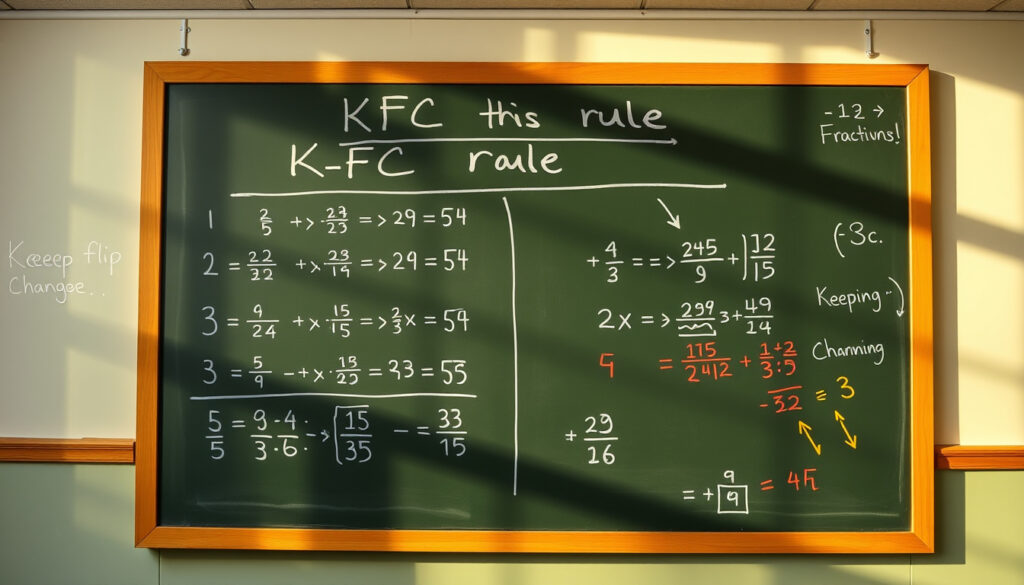
How to Divide Fractions: Step-by-Step Guide with KFC Rule
Most people freeze when they see a fraction division problem. The numbers look strange, the operation feels backward, and suddenly that simple homework sheet turns intimidating. But fraction division has a secret weapon: a three-step trick so reliable that math teachers and video tutors alike have built entire lessons around it. Once you know it, you’ll never stare at a fraction division problem the same way again.
Core Method: Keep-Change-Flip (KFC) · Key Step: Flip second fraction to reciprocal · Example: 3/5 ÷ 1/2 = 1.2
Quick snapshot
- KFC is standard method per Khan Academy (Khan Academy)
- Reciprocal flips numerator and denominator (Math Tutor on YouTube)
- Result: 3/5 ÷ 1/2 = 6/5 = 1.2 (Khan Academy example)
- No direct BBC Bitesize sources found for KFC method
- KFC origin and standardization path unclear
- Limited documented comparison with other mnemonics
- Cornell Notes on KFC published 2014-11-24 (Cornell Notes on Scribd)
- Emma’s blog post on KFC 2017-06-21 (Emma’s Blog)
- Khan Academy 6th-grade unit ongoing since 2010s (Cornell Notes on Scribd)
- Master whole numbers (write as denominator 1)
- Tackle mixed numbers (convert to improper first)
- Apply shortcut for same-denominator divisions
These definitions and examples form the foundation of the KFC method used throughout the article.
| Term | Definition |
|---|---|
| Standard Rule | Keep-Change-Flip |
| Reciprocal Action | Invert divisor fraction |
| BBC Summary | Keep, change ÷ to ×, flip second |
| Example Output | 3/4 ÷ 1/2 = 1.5 |
How to divide fractions step by step?
Fraction division follows a strict three-step sequence that transforms division into multiplication. According to Khan Academy’s dividing fractions tutorial, the first step is finding the reciprocal of the divisor. You flip the second fraction upside down—so 2/3 becomes 3/2—then multiply the first fraction by this inverted form.
Keep the first fraction
Leave the first fraction exactly as written. If you’re solving 3/4 ÷ 2/5, you keep 3/4 unchanged throughout the entire process.
Change the division sign to multiplication
Replace every ÷ with ×. This is the second transformation in the sequence.
Flip the second fraction
Take the divisor (the second fraction) and invert it—swap the numerator and denominator. The reciprocal of 2/5 is 5/2. Then multiply straight across: 3/4 × 5/2 = 15/8. Khan Academy’s review article confirms this three-step sequence works for any fraction division problem.
The implication: once you internalize these three moves, every fraction division problem becomes a simple multiplication task with one extra flip step.
What is the KFC rule in math?
The KFC rule is a memory aid that makes fraction division almost automatic. As documented in a popular math tutorial on YouTube, KFC stands for Keep the first fraction, Flip the second fraction to its reciprocal, and Change the division sign to multiplication.
Keep first fraction unchanged
The first fraction stays in its original form. Nothing gets modified.
Change ÷ to ×
Division becomes multiplication. This is the crucial transformation that makes the entire method work.
Flip second fraction
The divisor flips over. A fraction like 4/5 becomes 5/4. As Emma’s math blog explains, this step is what actually solves the problem—you’re multiplying by the reciprocal rather than dividing.
The pattern: KFC transforms every fraction division problem into a multiplication problem you already know how to solve. Students who struggle with division suddenly find multiplication manageable.
KFC works only for dividing fractions—it does not apply to adding or subtracting fractions. Adding fractions requires a different common denominator approach.
How do you divide two fractions together?
Working through a concrete example shows exactly how KFC operates in practice. Let’s solve 2/5 ÷ 7/3 step by step.
Example: 3/5 ÷ 1/2
Following KFC: keep 3/5, change ÷ to ×, flip 1/2 to 2/1. Multiply: 3/5 × 2/1 = 6/5 = 1.2. This matches Khan Academy’s worked example.
Step-by-step multiplication
Multiply numerators together: 2 × 3 = 6. Multiply denominators: 5 × 7 = 35. Result: 6/35. You can verify this with Khan Academy’s practice problems.
Verify with Khan Academy
Khan Academy uses number lines to explain why this works conceptually. A Khan Academy video on understanding division of fractions shows that dividing by 2/3 is equivalent to multiplying by 3/2. The number line approach—counting jumps of the divisor size until you reach the dividend—visually confirms the same result.
What this means: the flip-and-multiply method isn’t just a shortcut; it’s rooted in how fractions fundamentally work as division problems.
If you divide a larger fraction by a smaller one (like 3/4 ÷ 1/2), the result will always be greater than 1. Khan Academy’s review confirms this quick sanity check helps catch errors.
How to divide fractions with whole numbers?
Whole numbers hide a secret: they’re fractions in disguise. Any whole number n equals n/1. This means the KFC method works without modification—you just write the whole number as a fraction first.
Convert whole to fraction
Write 4 as 4/1. Now you have a standard fraction division problem: 1/5 ÷ 4/1.
Apply KFC
Keep 1/5, change ÷ to ×, flip 4/1 to 1/4. Multiply: 1/5 × 1/4 = 1/20. This technique is demonstrated in a Khan Academy video on dividing whole numbers and fractions.
Simplify
The result 1/20 is already in lowest terms. Always check whether your answer can be reduced further before moving on.
The catch: students often forget that the whole number becomes the divisor in the flip step. Writing it as /1 makes the reciprocal operation obvious.
How to divide fractions with mixed numbers?
Mixed numbers like 2½ require one conversion step before KFC takes over. You must transform them into improper fractions first.
Convert to improper fractions
Take 2½: multiply the whole number (2) by the denominator (2) and add the numerator (1). 2 × 2 + 1 = 5. The improper fraction is 5/2.
Divide using reciprocal
Now apply KFC to the improper fractions. If dividing 5/2 ÷ 3/4, keep 5/2, change ÷ to ×, flip 3/4 to 4/3. Multiply: 5/2 × 4/3 = 20/6 = 10/3.
Convert back if needed
Turn 10/3 back into a mixed number: 10 ÷ 3 = 3 with remainder 1, so 3⅓. This step applies only if your answer needs conversion back to mixed form.
The implication: the extra conversion step is where most errors happen. Converting carefully and completely before applying KFC prevents downstream mistakes.
How to divide fractions with same denominators?
When both fractions share the same denominator, you get a shortcut: divide the numerators directly. For 6/7 ÷ 2/7, simply calculate 6 ÷ 2 = 3. The common denominator cancels out.
Direct numerator division
The rule works because dividing fractions with common denominators reduces to dividing the numerators. You can verify this with KFC: 6/7 ÷ 2/7 becomes 6/7 × 7/2 = 42/14 = 3. Same result, less work.
When to use the shortcut
Apply this shortcut when you spot matching denominators. It saves time and simplifies mental math, but KFC always works as a backup.
Why this matters: recognizing patterns like same-denominator division builds number sense that extends beyond rote calculation.
How to divide fractions with variables?
Variable expressions follow the same KFC rules. The process doesn’t change—only the numbers do. If you have (3x/4) ÷ (2y/5), you still flip the second fraction and multiply.
Apply KFC to algebraic fractions
Keep 3x/4, change ÷ to ×, flip 2y/5 to 5/2y. Multiply: (3x × 5)/(4 × 2y) = 15x/8y. Variables behave exactly like numbers in the flip-and-multiply process.
Simplify variables
Cancel common factors just as you would with numbers. If x appears in numerator and denominator, it cancels out following standard algebraic rules.
The implication: KFC provides a reliable procedure even when concrete numbers are absent. The method scales from arithmetic to algebra seamlessly.
Khan Academy (Educational Platform)
“So we swap the numerator and the denominator. So we multiply it times 3/2.” — Sal Khan, Khan Academy
Emma’s Blog (Math Educator)
“Whenever you see the symbol for division between two fractions, just think of KFC.” — Emma, Math Blogger
How to divide fractions into decimals?
Every fraction represents a division problem waiting to be solved. Converting to decimals is the final step after applying KFC.
Use KFC first
Solve the fraction problem completely: 3/4 ÷ 1/2 = 3/4 × 2/1 = 6/4 = 3/2.
Divide numerator by denominator
Calculate 3 ÷ 2 = 1.5. This decimal result represents the same value as the fraction 3/2.
The trade-off: decimals can be easier to compare visually, but fractions preserve exact values and are essential for algebraic work.
Related reading: How Many Fluid Ounces in a Cup · How Many Ounces in a Pound
youtube.com, youtube.com, youtube.com, khanacademy.org, youtube.com
The KFC rule simplifies division by turning it into multiplication after flipping the second fraction, so practicing how to multiply fractions first strengthens your foundation.
Frequently asked questions
What is the trick for dividing fractions?
The KFC method (Keep-Change-Flip) transforms fraction division into multiplication. Keep the first fraction, change ÷ to ×, and flip the second fraction to its reciprocal. Multiply the resulting numerators and denominators, then simplify.
How to divide a fraction by itself?
Any fraction divided by itself equals 1. Using KFC: 3/4 ÷ 3/4 becomes 3/4 × 4/3 = 12/12 = 1. The numerator and denominator cancel completely.
How to divide fractions with same denominators?
When denominators match, divide the numerators directly. For 5/8 ÷ 3/8, simply calculate 5 ÷ 3 = 5/3. The common denominator cancels out during division.
How to divide fractions into decimals?
First apply KFC to solve the division, then divide the final numerator by the denominator. For 2/5 ÷ 1/4: result is 8/5 = 1.6 (calculated as 8 ÷ 5).
How to divide fractions with variables?
Variables follow identical KFC rules. Keep the first algebraic fraction, change ÷ to ×, flip the second, then multiply. Cancel common factors algebraically just as with numerical fractions.
How to divide fractions for kids?
Start with the KFC mnemonic and visual examples. Use number lines from Khan Academy’s conceptual videos to show why flipping works. Keep problems simple: ½ ÷ ¼ means “how many quarters fit in a half?”
More related posts
 Gears of War E-Day: Release Date, Platforms & Trailer
 Which of the Following: Meaning, Usage, and Grammar Guide
 Theo James Movies and TV Shows: Complete Filmography
 Best Cheese for Grilled Cheese: Chefs’ Secrets & Top Picks
 How to Do a Pull Up: Beginner’s Guide to First Rep (30-Day Plan)
 How to Spatchcock a Turkey – Even Cooking and Crisp Skin
 Deborra-Lee Furness: Age, Net Worth, and Her Statement
 Cracker Barrel Near Me: Find Locations, Menus & Hours