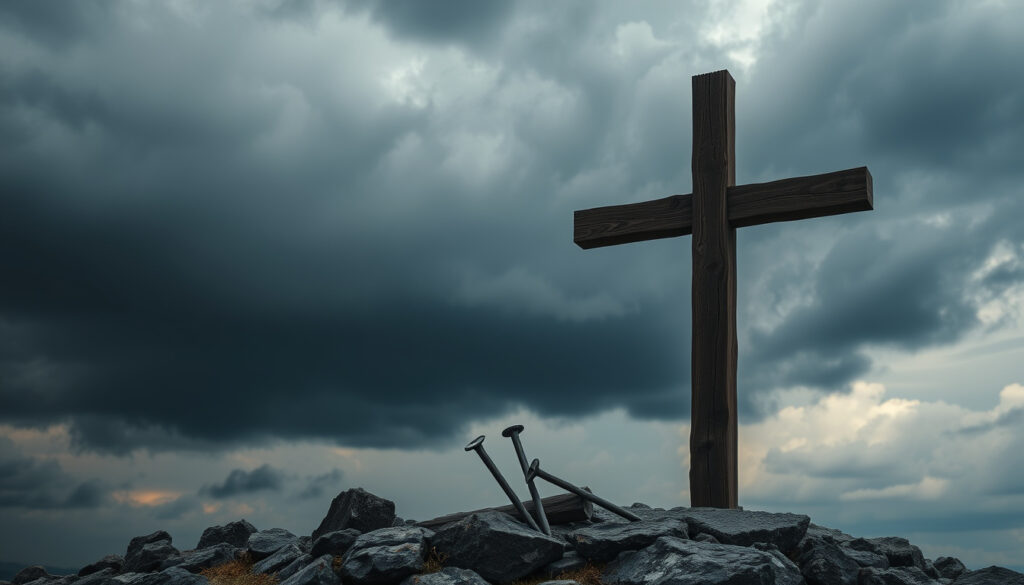
Jesus on the Cross: Meaning, Seven Last Words, and Key Questions
Few symbols are as instantly recognizable as the cross, yet the words Jesus spoke while hanging on it are often less familiar. Drawn from all four Gospels, these seven sayings form a compact devotional tradition that has shaped Christian theology for two millennia.
Seven last words of Jesus: 7 sayings ·
Approximate year of crucifixion: AD 30–33 ·
Gospels recording crucifixion: 4 (Matthew, Mark, Luke, John) ·
Hours on the cross: ~6 hours (9 AM to 3 PM)
Quick snapshot
- Jesus was crucified under Pontius Pilate (Wikipedia (open encyclopedia))
- Jesus died on the cross (Britannica (encyclopedia))
- Jesus spoke seven last sayings recorded in the Gospels (Catholic Resources (theological reference site))
- Exact time of crucifixion (hour uncertain) (GotQuestions (Christian Q&A site))
- Order of the seven sayings (Catholic Resources (theological reference site))
- Age of Mary and Joseph at Jesus’ birth (Catholic.com (Catholic apologetics))
- Night before crucifixion – arrest in Gethsemane (Bible Gateway (online Bible))
- 9 AM – crucifixion begins (Britannica (encyclopedia))
- 12 PM – 3 PM – darkness over the land (GotQuestions (Christian Q&A site))
- 3 PM – Jesus dies (Bible Gateway (online Bible))
- Resurrection on the third day (Wikipedia (open encyclopedia))
- Christian hope of eternal life through the cross (Christianity.com (Christian resource site))
Five key facts about the crucifixion, drawn from Gospel accounts and historical sources:
| Fact | Value |
|---|---|
| Crucifixion date | c. AD 33 |
| Number of last sayings | 7 |
| Biblical books covering crucifixion | Matthew, Mark, Luke, John |
| Years of Jesus’ public ministry | ~3 |
| Approximate age at death | ~33 |
What are the seven last words of Jesus on the cross?
The traditional “Seven Last Words” are a devotional compilation drawn from all four Gospels — no single Gospel contains all seven. According to Catholic Resources (theological reference site), the sayings are recorded in Luke, John, Matthew, and Mark. The order below follows the most common devotional sequence.
“Father, forgive them, for they know not what they do” (Luke 23:34)
- This first saying shows Jesus interceding for those crucifying him. Wikipedia (open encyclopedia) notes it is often read as an example of radical forgiveness.
“Today you will be with me in paradise” (Luke 23:43)
- Spoken to the repentant thief, this saying offers assurance of immediate salvation. According to GotQuestions (Christian Q&A site), it emphasizes that faith, not works, grants entry to paradise.
“Woman, behold your son” (John 19:26-27)
- Jesus entrusts his mother Mary to the beloved disciple, creating a new family bond. Catholic Resources (theological reference site) highlights this as a demonstration of Jesus’ care even in suffering.
“My God, my God, why have you forsaken me?” (Matthew 27:46 / Mark 15:34)
- This Aramaic cry quotes Psalm 22, expressing both anguish and trust. Catholic Resources (theological reference site) connects it to the theme of righteous suffering.
“I thirst” (John 19:28)
- A statement that fulfills Scripture (Psalm 69:21). GotQuestions (Christian Q&A site) observes that it shows Jesus’ full humanity.
“It is finished” (John 19:30)
- A declaration that Jesus’ saving work is complete. GotQuestions (Christian Q&A site) notes that the Greek word “tetelestai” carries the sense of a debt paid in full.
“Father, into your hands I commit my spirit” (Luke 23:46)
- The final saying expresses voluntary surrender. According to GotQuestions (Christian Q&A site), it echoes Psalm 31:5 and shows Jesus’ trust in the Father at death.
The seven sayings are not a transcript from a single eyewitness, but a faithful compilation. For those seeking to understand Jesus’ final hours, the tradition offers a coherent portrait of forgiveness, compassion, suffering, and completion.
The pattern: Each saying addresses a different aspect of Jesus’ mission — forgiveness, salvation, family, abandonment, physical need, completion, and trust. Together they form a theological arc that Christians have reflected on for centuries.
What sins will God never forgive?
According to Bible Gateway (online Bible), Jesus explicitly teaches that blasphemy against the Holy Spirit is the unforgivable sin. This has generated considerable discussion.
What is the blasphemy against the Holy Spirit?
- Theologians generally interpret it as a persistent, willful rejection of the Spirit’s testimony about Christ. GotQuestions (Christian Q&A site) explains that it is not a single curse but a hardened refusal to accept God’s forgiveness, which by its nature remains unforgiven.
Many believers worry they have committed this sin. According to Catholic.com (Catholic apologetics), the very concern about having committed blasphemy against the Holy Spirit is itself evidence that one has not — because the sin involves a hardened heart that does not care.
The trade-off: While most sins can be forgiven through repentance, the one that cuts off repentance itself cannot be forgiven. For the sincere believer, this is a category reserved for persistent rejection, not a momentary lapse.
Will husband and wife know each other in heaven?
Jesus addresses this directly in the Gospels. According to Bible Gateway (online Bible), he says, “At the resurrection people will neither marry nor be given in marriage; they will be like the angels in heaven.”
Will there be marriage in heaven?
- Jesus’ words indicate that marriage is an earthly institution that does not continue in the same form. However, GotQuestions (Christian Q&A site) suggests that believers will recognize each other and enjoy relationships transformed, not erased.
What does the Bible say about recognition in the afterlife?
- Several passages imply recognition, such as the Transfiguration (Moses and Elijah recognized) and the parable of the rich man and Lazarus. Christianity.com (Christian resource site) argues that our identity and relationships will be preserved and perfected.
What this means: While marriage as a covenant ends, the deep bonds of love and knowledge are not lost. For those who fear losing their closest relationships, the Bible offers hope of continued, albeit transformed, connection.
Why do Catholics touch their forehead, lips, and chest?
This gesture is part of the Sign of the Cross, a prayer invoking the Trinity. According to Catholic.com (Catholic apologetics), the forehead, lips, and chest are touched during a particular form of the Sign of the Cross before the Gospel reading.
What is the sign of the cross?
- The Sign of the Cross is a symbolic gesture that calls to mind the Trinity and the crucifixion. The large sign (touching forehead, chest, shoulders) is used at the beginning and end of prayers. The small sign (thumb tracing a cross on forehead, lips, and chest) is made before the Gospel.
What do the forehead, lips, and chest gestures mean?
- A traditional explanation: forehead represents the Father (source of wisdom), lips represent the Son (the Word), and chest represents the Holy Spirit (dwelling in the heart). New Advent (Catholic Encyclopedia) notes that this small sign is a petition for the Gospel to be in one’s mind, on one’s lips, and in one’s heart.
The implication: For Catholics, this gesture is not superstition but a embodied prayer, inviting the Trinity into every aspect of the person — intellect, speech, and affections.
What is the meaning of Jesus on the cross?
The cross is central to Christianity as the place of atonement. According to Bible Gateway (online Bible), Paul writes that Jesus’ death is a “sacrifice of atonement” through faith in his blood.
What did Jesus accomplish on the cross?
- Christians believe Jesus’ death secured salvation and reconciliation with God. Britannica (encyclopedia) explains that the cross demonstrates God’s justice (sin is punished) and love (God provides the sacrifice).
What is the atonement?
- Atonement refers to the reconciling act that addresses human sin. Different Christian traditions emphasize various models, but the core is that Jesus took the penalty of sin on himself. For a deeper exploration, read I Can Only Imagine: True Story, Father Abuse, and Where to Watch.
Why this matters: The cross is not merely a historical event but the hinge of Christian faith. It answers the problem of sin with a solution that costs God everything — a pattern that challenges any notion of cheap grace.
Confirmed facts
- Jesus was crucified under Pontius Pilate (Wikipedia (open encyclopedia))
- Jesus died on the cross (Britannica (encyclopedia))
- Jesus spoke seven last sayings recorded in the Gospels (Catholic Resources (theological reference site))
What’s unclear
- Exact time of crucifixion: hour uncertain (GotQuestions (Christian Q&A site))
- Order of the seven sayings (Catholic Resources (theological reference site))
- Age of Mary and Joseph at Jesus’ birth (Catholic.com (Catholic apologetics))
“Father, forgive them; for they do not know what they do.”
— Jesus, Luke 23:34 (Bible Gateway (online Bible))
“It is finished.”
— Jesus, John 19:30 (Bible Gateway (online Bible))
The cross is more than a historical execution; it is the event that, for Christians, redefines love, justice, and hope. For the believer standing before it, the choice is clear: accept the forgiveness offered, or stay in the darkness that the cross overcame. For readers exploring these questions, the cross invites not just intellectual assent but a transformed life. As with the film I Can Only Imagine, the story of the cross remains one of redemption that touches even the hardest heart.
openthebible.org, facebook.com, sistersofmercy.org, blogs.efca.org, focusonthefamily.ca, christianity.com, revival.tv, facebook.com, youtube.com
Frequently asked questions
What does the cross symbolize in Christianity?
The cross symbolizes Jesus’ sacrifice for sin and the victory of love over death. It is both a reminder of suffering and a sign of hope.
Why is the cross used as a symbol of faith?
Because Jesus died on a cross, it became the central emblem of Christianity, representing salvation and the new covenant.
How did crucifixion kill?
Crucifixion caused death through a combination of blood loss, asphyxiation, and shock. The victim’s position made breathing difficult, leading to respiratory failure.
What is the difference between a crucifix and a plain cross?
A crucifix includes the figure of Jesus (corpus), emphasizing his suffering; a plain cross is empty, representing the resurrection. Both are used in different denominations.
What does the INRI sign on the cross mean?
INRI stands for “Iesus Nazarenus Rex Iudaeorum” — Latin for “Jesus of Nazareth, King of the Jews.” The sign was placed above Jesus’ head on the cross (John 19:19).
Did Jesus carry the entire cross to Golgotha?
According to the Gospels, Jesus carried the crossbeam (patibulum) part of the way, then Simon of Cyrene was forced to carry it (Mark 15:21).
What is the significance of the two thieves crucified with Jesus?
One thief mocked Jesus, the other repented and was promised paradise. Their contrasting responses illustrate the possibility of salvation even at the last moment (Luke 23:39-43).
More related posts
 James Webb Telescope Images: Latest Stunning Cosmic Views
 Tell Me Lies Season 4: No Renewal After Planned Finale
 What Is White Lotus About? Plot Cast Seasons Explained
 Car Accident Attorney Near Me: Ireland Claim Guide
 Current Movies in Theaters in Ireland | Omniplex Showtimes
 2025 Toyota RAV4 Hybrid – Specs, Trims and Pricing Guide
 When is Memorial Day 2026? Date, History & Key Traditions
 How to Spatchcock a Turkey – Even Cooking and Crisp Skin