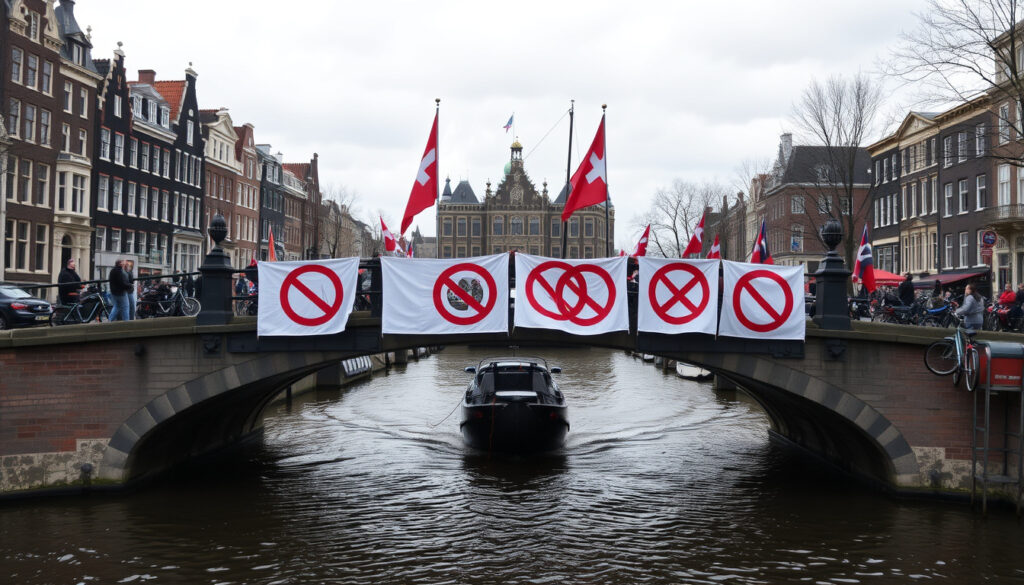
No Kings Day Protest – Timeline, Facts and Amsterdam Events
The No Kings protests, known as No Tyrants demonstrations in the Netherlands, emerged as a significant wave of grassroots opposition to Donald Trump’s second administration policies. Beginning in June 2025, these coordinated demonstrations grew into what organizers described as the largest sustained protest movement in recent American history, drawing millions of participants across thousands of locations in the United States and abroad.
In Amsterdam, the demonstrations took place outside the U.S. Consulate on Museumplein, with participants adapting the protest name to avoid confusion with the Dutch royal family’s King’s Day celebrations. The movement united Americans abroad with domestic protesters in opposing perceived threats to democratic institutions and international norms.
This guide provides a comprehensive overview of the protests’ origins, growth, and significance, drawing on available reports from news outlets and official organizer statements.
Overview: No Kings Day Protest Timeline and Key Facts
The No Kings movement evolved through three major protest waves between 2025 and 2026, with participation scaling from approximately five million to nearly nine million participants. What began as domestic American demonstrations quickly gained international traction.
- Record participation: The March 2026 demonstrations drew an estimated 8-9 million participants across 3,300+ locations, making this one of the largest protest events in recent history
- International reach: Though centered in the United States, the movement organized solidarity events in 20+ countries, including coordinated rallies in major European capitals
- Name adaptation: Dutch organizers rebranded the demonstrations as “No Tyrants” to prevent confusion with Koningsdag, the Dutch King’s Day celebration
- Nonviolent approach: Amsterdam events remained peaceful, with no reported arrests or violent incidents at the Museumplein demonstrations
- Grassroots coordination: Local chapters and individual volunteers, rather than established political organizations, drove international expansion
- Evolving demands: Initial opposition to Trump administration policies broadened to include issues such as immigration enforcement, international legal obligations, and democratic governance
| Fact | Details | Source |
|---|---|---|
| Event Name | No Kings Day / No Tyrants | Multiple sources |
| Peak Attendance (U.S.) | 8-9 million (March 2026) | Wikipedia, news reports |
| Amsterdam Attendance | 300+ (June 2025); few hundred (March 2026) | Democrats Abroad, DutchNews |
| Arrests | None reported at Dutch events | News coverage |
| Main Venue | Museumplein, outside U.S. Consulate | Event organizers |
| Primary Organizer | Hayley Hughes, Indivisible Netherlands | Democrats Abroad |
What Drove the No Kings Day Protests?
The demonstrations reflected widespread concern among certain American communities about the direction of federal policy under Trump’s second term. Organizers articulated multiple grievances, ranging from domestic governance concerns to foreign policy decisions.
Domestic Policy Criticisms
Protesters cited specific immigration enforcement actions as primary concerns. According to reports from DutchNews and video documentation, participants referenced incidents including shootings involving Immigration and Customs Enforcement operations in Minneapolis, where Alex Pretti and Renée Good were affected. The broader expansion of ICE activities drew particular criticism from organizers and attendees alike.
Concerns about democratic institutions featured prominently in messaging. Participants opposed what they characterized as efforts to suppress information, including delayed release of documents related to Jeffrey Epstein’s activities, and what organizers viewed as attacks on press freedom and judicial independence.
Foreign Policy and International Law
The decision to pursue military action against Iran without congressional authorization galvanized protesters who viewed the action as a violation of constitutional war powers. Amsterdam organizers emphasized themes of international cooperation and the importance of maintaining alliances with European partners.
Amsterdam rally materials highlighted opposition to authoritarian governance, support for global peace, preservation of U.S.-European alliances, and encouragement of absentee voting among eligible Americans residing abroad.
The “King Trump” Narrative
The protest name itself referenced criticism of Trump’s leadership style. The White House responded dismissively, with officials characterizing the demonstrations as symptoms of political opposition rather than legitimate civic concern. Prior to the 2026 events, administration social media accounts shared artificial intelligence-generated images depicting a military aircraft bearing Trump’s likeness flying over crowds of protesters.
How Did the Movement Spread Internationally?
American expatriates and international solidarity organizations played crucial roles in establishing the demonstrations beyond U.S. borders. The Netherlands became a focal point for European coordination, with Amsterdam serving as the primary Dutch venue.
Organizational Structure
The grassroots nature of the movement meant that international events often emerged from individual initiative rather than top-down coordination. Hayley Hughes, identified as a member of Indivisible Netherlands, facilitated the Amsterdam demonstrations. According to statements from Democrats Abroad, the events were member-initiated and not officially affiliated with the organization, though public promotion occurred through its channels.
Sarah Dachos contributed voter registration assistance at the March 2026 event, helping eligible Americans living in the Netherlands complete absentee ballot requests. This emphasis on voting reflected a broader strategy among organizers to translate protest energy into electoral participation.
European Solidarity Events
Beyond Amsterdam, demonstrations took place in London, Paris, Rome, and other major capitals. European participation numbered in the tens of thousands according to available video documentation. The coordinated timing allowed protesters to express solidarity with domestic American demonstrations while highlighting the international implications of U.S. policy decisions.
Data estimates for the U.S.-based protests were compiled by G. Elliott Morris and Xylom, demonstrating how grassroots movements increasingly rely on independent data analysts to substantiate attendance figures.
Official Responses to the Demonstrations
The protests elicited varied responses from political figures and institutions, reflecting the polarized nature of American political discourse.
Royal Concerns
Dutch royal family involvement became a point of contention when King Willem-Alexander and Queen Maxima planned an official visit to the White House in April 2026. Protest organizers publicly criticized the scheduled meeting, with one demonstrator, identified as Vitale, calling the planned visit “ridiculous” given the administration’s policies.
Political Characterization
Republican officials and the Trump administration responded dismissively to the demonstrations. A Republican spokesperson characterized the events as anti-American, while the White House employed dismissive terminology to describe the protests. The administration’s response contrasted with the scale of participation, which set records for coordinated protest events.
Notably, the Trump administration did not issue direct statements regarding the March 2026 rallies, departing from previous patterns of public response. News coverage from DutchNews and NL Times documented the Amsterdam events factually without official comment from Dutch government representatives.
Major wire services including Reuters and Dutch national broadcaster NOS did not publish dedicated statements about the Amsterdam demonstrations. Coverage remained limited to regional and specialized international news outlets.
Chronological Record of Major Demonstrations
The No Kings movement progressed through distinct phases, with participation growing substantially between the initial and final protest waves.
- — First No Kings Day demonstration. Over 5 million participants across 2,100+ U.S. locations. Philadelphia served as flagship city. First No Tyrants rally in Amsterdam drew more than 300 attendees to Museumplein.
- — Second wave of protests. Participation expanded to approximately 5-7 million across 2,700 locations, including National Mall, Chicago, and New York City. Amsterdam hosted a second rally at the same Museumplein venue.
- — Third and largest demonstration. Between 8-9 million participants across more than 3,300 events. Minnesota served as the flagship location, with musician Bruce Springsteen appearing. European cities including London, Paris, and Rome hosted solidarity events.
Attendance estimates for the Netherlands remained modest compared to American participation, though the events provided visible platforms for expatriate concerns about domestic U.S. policies.
What We Know—And What Remains Unclear
Available reporting provides a general picture of the demonstrations, though certain details warrant careful interpretation.
| Established Information | Remaining Uncertainties |
|---|---|
| Three major protest waves occurred between June 2025 and March 2026 | Exact attendance figures remain estimates, not verified counts |
| Amsterdam events remained peaceful with no reported arrests | Detailed demographic information about Dutch participants not publicly available |
| Hayley Hughes of Indivisible Netherlands organized Amsterdam rallies | Financial details and funding sources for international events unclear |
| Protests centered on opposition to Trump administration policies | Long-term organizational structure beyond individual events undefined |
| Demonstrators expressed concern about immigration enforcement and democratic governance | Impact of protests on actual policy changes difficult to assess |
Historical and Political Context
The No Kings protests emerged within a longer tradition of American civic mobilization responding to political developments. Constitutional debates over executive authority have surfaced repeatedly throughout American history, from founding-era disputes through twentieth-century wartime powers controversies.
The choice of protest location in Amsterdam reflected practical considerations rather than specific opposition to Dutch institutions. By adapting the movement’s name to “No Tyrants,” organizers acknowledged cultural sensitivities around royal celebrations while maintaining thematic consistency with the domestic message. The Netherlands has historically served as a venue for international solidarity demonstrations, with its permissive approach to assembly providing accessible options for expatriate activism.
Americans turned out for No Tyrants protest in Amsterdam, linking to U.S. solidarity rallies amid continued opposition to Trump administration policies.
— DutchNews coverage, March 2026
Primary Sources and Coverage
Reporting on the No Kings demonstrations drew from multiple source types, each offering distinct perspectives on the events.
Organizer statements provided direct insight into event rationale and structure. The Democrats Abroad event page documented logistical details and participant information for the October 2025 rally. Video documentation from YouTube captured aspects of the March 2026 demonstrations.
News outlets including DutchNews and NL Times offered factual reporting without editorial commentary. The Wikipedia entry on No Kings protests aggregated available information, though readers should note that crowd estimates cited specific data analysts rather than official counts.
The limited involvement of major wire services and Dutch national broadcasters meant that coverage remained concentrated among outlets with established expatriate readerships and international news focus.
Summary and Key Takeaways
The No Kings protests represented an unprecedented scale of civic mobilization against the Trump administration’s second-term policies, growing from approximately five million participants in June 2025 to nearly nine million by March 2026. International solidarity events, including the Amsterdam No Tyrants demonstrations, provided expatriate Americans opportunities to participate in the movement while highlighting concerns with broader international implications.
The protests remained peaceful throughout their Dutch iterations, with organizers emphasizing themes of democratic governance, international cooperation, and civic participation. Despite the scale of participation, official responses from the administration characterized the demonstrations dismissively, and policy changes directly attributed to protest activity remain difficult to establish.
For those interested in understanding the broader context of American civic traditions, the history of Susan B. Anthony – Pioneer of Women’s Suffrage demonstrates how grassroots movements have long shaped political participation in the United States.
Frequently Asked Questions
When did the No Kings protests begin?
The first major demonstrations occurred on June 14, 2025, with over 5 million participants across more than 2,100 locations in the United States and 20 countries.
Why were Dutch events called “No Tyrants” instead of “No Kings”?
Organizers chose “No Tyrants” to avoid confusion with Koningsdag, the Dutch King’s Day celebration honoring the royal family. The original protest name referenced opposition to perceived authoritarianism, not the Dutch monarchy.
Were there any arrests at the Amsterdam protests?
No arrests, police reports, or violent incidents were documented at the Dutch events. The Museumplein rallies remained peaceful throughout all three protest waves.
Who organized the Amsterdam demonstrations?
Hayley Hughes, affiliated with Indivisible Netherlands, served as primary organizer. The events were member-initiated rather than officially sponsored by established political organizations.
How many people participated in the protests?
Estimates ranged from over 5 million in June 2025 to approximately 8-9 million in March 2026, with attendance figures compiled by independent data analysts rather than official counts.
What were the main concerns expressed by protesters?
Demonstrators opposed perceived authoritarian governance, specific immigration enforcement actions, military action against Iran, and what they characterized as threats to democratic institutions and international legal norms.
Did the Dutch royal family respond to the protests?
The royal family did not issue public statements about the demonstrations. However, the planned White House visit by King Willem-Alexander and Queen Maxima in April 2026 drew criticism from protesters.
More related posts
 Best Places to Eat Near Me: Dublin, Galway & Cork Guide
 What Does WTW Mean? Text, Snapchat & Instagram Slang
 Helldivers 2 Update Today – No Patch Released April 7
 Royal Challengers Bengaluru vs Punjab Kings Timeline
 The Moment 2026 Showtimes: Where to Watch & Tickets
 Cleaning Services Near Me: Costs & 20-Minute Rule
 White Lotus Season 1: Recap, Cast & Ending
 Cast of Harry Potter 5: Order of the Phoenix Actors Guide