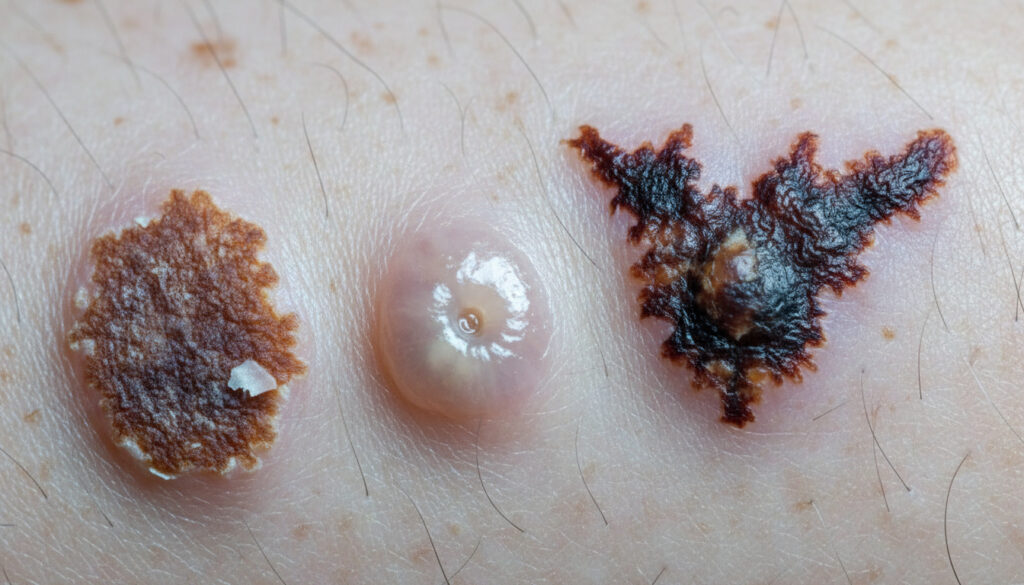
Types of Skin Cancer – Basal, Squamous, Melanoma Guide
Skin cancer represents the most commonly diagnosed malignancy in the United States, with medical professionals identifying over three million new cases annually. Diagnostic protocols classify these neoplasms into distinct categories based on cellular origin, metastatic potential, and clinical behavior. Accurate classification enables targeted treatment strategies and informs prognostic expectations for patients.
Oncologists categorize skin malignancies primarily as non-melanoma and melanoma variants. Non-melanoma cancers, comprising basal cell and squamous cell carcinomas, originate from epidermal keratinocytes and typically exhibit localized growth patterns. Melanoma develops from melanocytes, the pigment-producing cells, and demonstrates significantly higher metastatic capability. Rare neuroendocrine tumors such as Merkel cell carcinoma present aggressive clinical courses despite lower incidence rates.
What Are the Main Types of Skin Cancer?
| Type | Prevalence | Growth Pattern | Severity Profile |
|---|---|---|---|
| Basal Cell Carcinoma | 75–80% of cases | Slow, local invasion | Low mortality if treated |
| Squamous Cell Carcinoma | 20% of cases | Slow, <10% metastasis | Moderate risk |
| Melanoma | Less common | Rapid, high spread | Potentially lethal |
| Merkel Cell Carcinoma | Rare | Aggressive, fast | Very high risk |
- Basal cell carcinoma accounts for approximately eight in ten diagnosed skin malignancies, making it the most prevalent form.
- Ultraviolet radiation exposure serves as the primary etiological factor across all major classification categories.
- Non-melanoma variants rarely prove fatal when detected during localized stages.
- Melanoma and Merkel cell carcinoma demonstrate the highest propensity for distant metastasis.
- Recent epidemiological trends indicate rising incidence of basal cell carcinoma among women and younger demographics.
- More than three million Americans receive skin cancer diagnoses each year.
- Early detection protocols significantly reduce mortality rates for localized disease presentations.
| Classification | Cell of Origin | Prevalence Data | Metastasis Risk | Primary Anatomic Sites |
|---|---|---|---|---|
| Basal Cell Carcinoma | Basaloid follicular cells | 75–80% of diagnoses | Rare | Face, scalp, neck |
| Squamous Cell Carcinoma | Keratinocytes | 20% of diagnoses | <10% within 2 years | Head, arms, legs |
| Melanoma | Melanocytes | Less common | High | Trunk, legs, anywhere |
| Merkel Cell Carcinoma | Neuroendocrine cells | Rare | Very high | Sun-exposed skin |
| Nodular BCC | Basal cells | Most common BCC subtype | Rare | Face |
| Superficial BCC | Basal cells | Common variant | Rare | Trunk, limbs |
| Infiltrative BCC | Basal cells | Aggressive subtype | Local invasion | Any site |
| Bowen Disease | Squamous cells | SCC in situ | Low if treated | Sun-exposed areas |
| Sebaceous Carcinoma | Sebaceous glands | Rare | Variable | Eyelids, skin |
| Kaposi Sarcoma | Endothelial cells | Rare | Variable | Skin, mucosa |
Medical data from Cancer Center and Fred Hutchinson Cancer Research Center confirm these prevalence distributions. Basal cell carcinoma predominates in clinical practice, while melanoma accounts for the majority of skin cancer-related mortality despite lower incidence.
What Is Basal Cell Carcinoma and Squamous Cell Carcinoma?
How Does Basal Cell Carcinoma Develop?
Basal cell carcinoma originates from the basaloid cells residing at the epidermis-dermis interface. Pathological examination reveals four primary subtypes: nodular, superficial, infiltrative (sclerosing), and pigmented variants. Nodular basal cell carcinoma presents as pearly, waxy nodules with visible telangiectasias, typically affecting facial skin. Superficial variants manifest as red, scaly patches on trunk and extremities, while infiltrative subtypes demonstrate aggressive local tissue invasion despite rare metastatic spread.
Dermatopathologists classify basal cell carcinomas based on histological architecture. Nodular represents the most frequently encountered variant, characterized by circumscribed, translucent papules. Infiltrative subtypes require more extensive surgical margins due to poorly defined borders, though all BCC variants demonstrate low metastatic potential according to American Cancer Society documentation.
What Characterizes Squamous Cell Carcinoma?
Squamous cell carcinoma arises from keratinocytes within the epidermal upper layers and underlying hair follicles. Clinical presentations include scaly erythematous patches, persistent sores, or raised growths with central ulceration. Bowen’s disease represents the in situ precursor, appearing as persistent red, scaly plaques. Unlike basal cell carcinoma, squamous cell carcinoma maintains a documented metastasis rate approaching ten percent within two years of diagnosis, particularly affecting lymph nodes and visceral organs.
Risk stratification identifies outdoor occupational exposure as a significant factor, with older male workers historically showing highest incidence rates, though recent data suggests increasing frequency among women and younger populations. Unlike the Cast of St Denis Medical, which portrays fictionalized hospital scenarios, dermatological diagnosis relies on histopathological confirmation through biopsy.
What Is Melanoma and Why Is It Different?
What Cellular Mechanisms Define Melanoma?
Melanoma develops from malignant transformation of melanocytes, the neural crest-derived cells responsible for pigment synthesis. This origin explains the propensity for rapid metastasis via both lymphatic and hematogenous routes. Clinical observation indicates that melanoma frequently evolves from pre-existing nevi or appears de novo as irregular pigmented lesions. The biological behavior distinguishes melanoma from non-melanoma cancers, with established potential for distant metastasis even from thin primary lesions.
How Do Detection Protocols Identify Melanoma?
Dermatologists utilize the ABCDE mnemonic to facilitate early recognition: Asymmetry of lesion halves, Border irregularity, Color variation within the lesion, Diameter exceeding six millimeters, and Evolution or change over time. These characteristics differentiate malignant melanoma from benign melanocytic nevi. Yale Medicine emphasizes that melanoma ranks as the most dangerous non-rare skin cancer type due to this metastatic capability.
How Do the Types of Skin Cancer Differ?
What Distinguishes Melanoma from Non-Melanoma Variants?
Non-melanoma skin cancers—specifically basal cell and squamous cell carcinomas—exhibit relatively indolent growth patterns with rare distant metastasis when treated appropriately. These lesions typically remain localized to sun-exposed anatomical regions such as the face, neck, and dorsal hands. Conversely, melanoma demonstrates aggressive biological behavior with potential for systemic dissemination from any cutaneous site, including areas without significant solar exposure. Merkel cell carcinoma, though statistically rare, exhibits metastatic potential comparable to melanoma.
Merkel cell carcinoma, arising from neuroendocrine cells within the skin, presents as firm red nodules on sun-damaged skin. Research from medical oncology centers indicates associations with both ultraviolet radiation exposure and Merkel cell polyomavirus infection. This rare entity demonstrates rapid metastatic spread and requires aggressive multimodal therapy.
Which Rare Types Require Special Consideration?
Beyond the three predominant categories, sebaceous gland carcinoma and Kaposi’s sarcoma represent additional rare variants. Sebaceous carcinoma typically affects periocular regions and demonstrates potential for local aggression. Kaposi’s sarcoma, associated with immunosuppression and viral etiology, presents as vascular patches or nodules. Mohs surgical practices document these entities as requiring specialized therapeutic approaches distinct from standard excisional protocols.
Basal cell carcinomas typically present as pearly papules with telangiectasia, while squamous cell lesions show hyperkeratotic scaling. Melanomas display asymmetry and color variegation. Merkel cell lesions appear as shiny red nodules without scaling. Visual differentiation guides biopsy decisions, though histopathology remains definitive.
Comparative analysis reveals that while basal cell carcinoma prevails numerically, melanoma and Merkel cell carcinoma account for disproportionate mortality. University of Maryland Medical Center data confirms that non-melanoma types rarely prove fatal when localized, whereas melanoma presents life-threatening risk. The Apple At Home Support Job represents unrelated employment sectors, yet understanding these medical distinctions remains essential for public health literacy.
How Has Medical Understanding of Skin Cancer Evolved?
- : Clinical documentation of basal cell carcinoma as distinct pathological entity
- : Recognition of squamous cell carcinoma invasive patterns and lymphatic spread
- : Jean Étienne Deonne establishes “melanoma” terminology in medical literature
- : Commercial development of ultraviolet-blocking topical preparations
- : FDA approval of immunotherapy agents for metastatic melanoma treatment
- : Identification of Merkel cell polyomavirus role in neuroendocrine skin tumors
What Do Researchers Know for Certain About Skin Cancer Types?
| Established Evidence | Ongoing Investigation |
|---|---|
| Ultraviolet radiation causes approximately 90% of non-melanoma skin cancers | Genetic triggers in 10% of cases without clear UV exposure history |
| Basal cell carcinoma represents the most prevalent cutaneous malignancy | Long-term immunotherapy efficacy for advanced Merkel cell carcinoma |
| Melanoma demonstrates the highest metastatic potential among common types | Precise progression timelines from dysplastic nevus to invasive melanoma |
| Squamous cell carcinoma carries <10% metastasis risk within two years | Environmental cofactors in virus-associated Merkel cell development |
What Factors Contribute to Different Skin Cancer Types?
Ultraviolet radiation exposure from solar or artificial tanning sources constitutes the primary etiological agent across all major skin cancer categories. Fair-skinned individuals with reduced melanin protection exhibit heightened vulnerability. Occupational exposure affects agricultural and construction workers disproportionately, though demographic shifts show increasing incidence among women and younger cohorts. Human papillomavirus infection correlates with anogenital squamous cell carcinoma variants.
Merkel cell carcinoma pathogenesis involves dual factors: ultraviolet-induced mutagenesis and Merkel cell polyomavirus integration. Immunosuppressed populations, including organ transplant recipients, demonstrate elevated risk for aggressive squamous cell carcinoma and Kaposi’s sarcoma. Epidemiological surveillance from oncology practices confirms that geographic latitude and cumulative sun exposure correlate with incidence rates.
What Do Leading Medical Authorities Report?
Basal cell and squamous cell skin cancers are the most common types of skin cancer, often developing on sun-exposed areas of the body where ultraviolet radiation causes cumulative cellular damage.
American Cancer Society
While melanoma is less common than basal cell or squamous cell carcinoma, it causes the majority of skin cancer deaths due to its ability to metastasize to lymph nodes and distant organs.
Fred Hutchinson Cancer Research Center
What Are the Essential Takeaways About Skin Cancer Types?
Basal cell carcinoma dominates clinical presentations with indolent growth and excellent prognosis, while squamous cell carcinoma requires monitoring for occasional metastatic potential. Melanoma demands urgent attention despite lower incidence, given its lethal metastatic capability. Rare entities such as Merkel cell carcinoma necessitate specialized oncological management. Early detection through regular dermatological examination remains the most effective strategy across all classifications. Those interested in unrelated career sectors may review the Apple At Home Support Job, though medical consultation should guide health decisions.
Frequently Asked Questions
What causes different types of skin cancer?
Ultraviolet radiation exposure constitutes the primary causative factor for basal cell, squamous cell, and melanoma. Merkel cell carcinoma involves both UV exposure and polyomavirus infection. Genetic susceptibility and immunosuppression contribute to risk profiles.
Can skin cancer be cured if caught early?
Basal cell and squamous cell carcinomas achieve high cure rates through surgical excision when localized. Melanoma prognosis depends on Breslow thickness and staging at detection. Early-stage Merkel cell carcinoma requires aggressive multimodal therapy.
Who is at highest risk for melanoma?
Individuals with fair skin, numerous atypical nevi, family history of melanoma, or history of severe sunburns face elevated risk. Outdoor workers and tanning bed users demonstrate increased incidence regardless of baseline pigmentation.
How quickly does squamous cell carcinoma spread?
Metastasis occurs in fewer than 10% of cases within the first two years following diagnosis. High-risk features include size exceeding two centimeters, depth of invasion, and perineural involvement.
Is Merkel cell carcinoma contagious?
The Merkel cell polyomavirus associated with this cancer is common in the general population, but the cancer itself does not transmit between individuals. Viral infection alone rarely causes malignancy without additional UV-induced mutations.
What distinguishes nodular basal cell carcinoma?
Nodular BCC presents as pearly, translucent papules with visible blood vessels and rolled borders. This subtype represents the most common BCC variant and typically affects facial skin.
How does Bowen disease relate to squamous cell carcinoma?
Bowen disease represents squamous cell carcinoma in situ, confined to the epidermis without dermal invasion. Untreated lesions may progress to invasive SCC with metastatic potential.
More related posts
 Inter vs River Plate: Match Result and Highlights (2025)
 White Lotus Season 1: Recap, Cast & Ending
 Amazon Product Recall Alert – Check Orders Get Refunds 2024
 Apple Stock Price Today: Live Quote, Forecast & Analysis
 The Forge Roblox Codes – Active List and Redemption Guide
 Port Vale vs Arsenal: Score, Highlights, Report | Carabao Cup
 Herpes Photos in Different Stages – Spot Outbreaks Early
 Where Was Jesus Born? Bethlehem in Judea Bible Facts