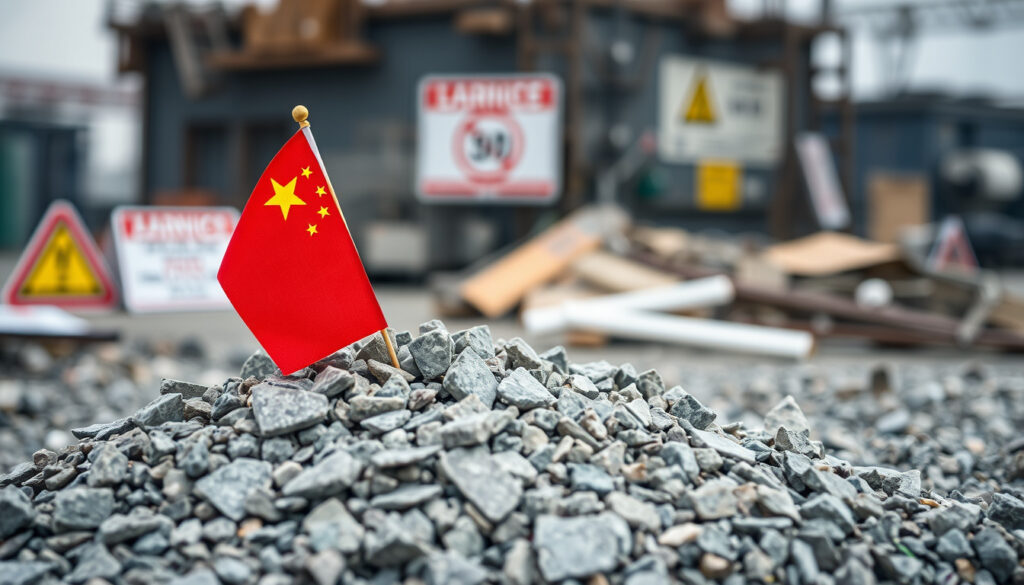
China Minerals Supply Disruption: Rare Earth Export Controls
When China tightened its grip on rare earth exports in 2025, it sent a jolt through industries from defense to electric vehicles. The world suddenly realized how dependent it is on a single country for the minerals that power modern technology. Here’s what the rare earth supply crunch means for the US, Europe, and global supply chains — and how governments are racing to catch up.
China’s share of global rare earth mining: 70% ·
US rare earth mine in operation: Mountain Pass, California (only one) ·
Date of China’s latest export restrictions: October 9, 2025 ·
Number of rare earth elements restricted: 7 ·
Global rare earth reserves (total): 120 million metric tons ·
China’s rare earth reserves: 44 million metric tons
Quick snapshot
- 70% of global rare earth mining is in China (IEA policy tracker)
- China imposed export controls on 7 rare earth elements in October 2025 (Wikipedia)
- Mountain Pass is the only active US rare earth mine (Wikipedia)
- Whether China’s export controls will escalate further
- How quickly the US and EU can build alternative processing capacity
- The exact untapped reserves in Vietnam and Brazil
- Whether the one-year suspension of some controls will hold
- April 4, 2025 – first export controls on 7 rare earths (IEA)
- October 9, 2025 – expansion to 12 restricted elements (Reuters)
- December 1, 2025 – foreign firms using Chinese rare earth tech face restrictions (CSET Georgetown)
Six key facts at a glance.
| Fact | Value |
|---|---|
| China’s rare earth mining share | 70% |
| US rare earth mine | Mountain Pass, California (owned by MP Materials) (Wikipedia) |
| Date of export controls | October 9, 2025 (Reuters) |
| Elements restricted | 7 (including neodymium, praseodymium, dysprosium) (Reuters) |
| Global reserves (total) | 120 million metric tons (Wikipedia) |
| China’s reserves | 44 million metric tons (Wikipedia) |
Which country has the most rare earth minerals?
Global rare earth reserves by country
China holds the largest rare earth reserves at 44 million metric tons, roughly 37% of the global total of 120 million metric tons, according to Wikipedia’s summary of USGS data. Vietnam, Brazil, and Russia also hold sizable deposits, but none come close to China’s scale.
One fact, one pattern: the top four countries control nearly 70% of known reserves.
| Country | Reserves (million metric tons) | Global share |
|---|---|---|
| China | 44 | 36.7% |
| Vietnam | 22 | 18.3% |
| Brazil | 21 | 17.5% |
| Russia | 12 | 10.0% |
| United States | 2.3 | 1.9% |
China’s dominant position in reserves and production
China not only holds the largest reserves but also dominates processing — about 90% of rare earth refining capacity resides there, as noted by the IEA policy tracker. This dual control gives Beijing enormous leverage over global supply.
Untapped reserves and future potential
Vietnam and Brazil have significant untapped deposits, but building mines and processing plants takes years. The CSIS notes that even with accelerated permitting, new US mines face a 7-10 year timeline.
Even if the US and Europe tap their reserves, they still lack the refining capacity to turn ore into usable magnets. China’s 90% processing share means building a parallel supply chain will take a decade or more.
The implication: reserves alone do not guarantee supply security — processing capacity is the real bottleneck.
Why don’t the U.S. mine its own rare earths?
History of US rare earth mining
America once led the world in rare earth production. The Mountain Pass mine in California was the global top producer until 2002, when environmental cleanup costs and low Chinese prices forced it to close, according to Wikipedia. It reopened in 2017 under MP Materials, but still ships concentrate to China for processing.
Environmental and regulatory hurdles
Permitting a new US mine takes 7–10 years on average, per CSIS. Strict environmental reviews and community opposition add further delays. China, by contrast, fast-tracked its mines with state backing and looser regulations.
Economic and supply chain factors
Chinese state subsidies kept rare earth prices artificially low for years, making it impossible for US operations to compete without government support, explains the Reuters analysis. Now that export controls have driven prices up, the economics are shifting — but the infrastructure gap remains.
For US defense contractors and EV makers (see our picks for Best Electric Cars 2025), the choice is stark: pay a 30% premium for magnets from non-Chinese sources, or risk supply chain freezes that could halt production lines.
The pattern: without a parallel processing infrastructure, US mines remain a partial solution.
Can China survive without US trade?
China’s record trade surplus and diversified exports
China’s trade surplus with the US hit a record in 2024, according to Reuters. Meanwhile, Beijing has redirected exports to Asia and Africa, reducing reliance on American buyers. The rare earth restrictions are not about survival — they are about leverage.
Dependence on US technology and agricultural imports
China still imports advanced semiconductors and aerospace components from the US, giving Washington some counter-leverage. But rare earths remain a one-sided weapon because alternatives are scarce.
Impact of US tariffs on China’s mineral exports
The SPF China Observer notes that the April 2025 export controls were explicitly framed as retaliation for US tariffs. The message: China can endure a trade war longer than its partners can endure a magnet shortage, a position reinforced by its naval and military capabilities (People’s Liberation Army Navy: 2026 Capabilities & Ranking).
What this means: the trade war is about leverage, not survival.
Does Europe have rare earth metals?
Known rare earth deposits in Europe
Europe has small but promising deposits in Sweden (Norra Kärr), Finland, and Greenland. The Norra Kärr deposit in Sweden is considered one of the largest undeveloped rare earth resources in Europe, per Wikipedia.
The mine at the centre of Europe’s push for freedom from China
The EU has designated Norra Kärr a “strategic project” under its Critical Raw Materials Act, aiming to accelerate permitting. But even with fast-tracking, production is not expected before 2028.
European Union’s critical minerals strategy
The IEA highlights the EU’s target to extract 10% of its critical minerals domestically by 2030, and to process 40% of its consumption. For rare earths, that target is far from reachable without major new mines.
What are the consequences of China’s new rare earths export restrictions?
Immediate impact on global supply chains
Within weeks of the April 2025 controls, prices for neodymium magnets surged 30%, according to CSIS. Defense contractors and EV manufacturers reported supply delays. The October 2025 expansion, covering 12 restricted elements, made matters worse by applying the rules to foreign goods containing even 0.1% Chinese-origin rare earths, per CSET Georgetown.
Retaliation and US response
The US announced new investments in domestic processing and recycling, but the gap remains vast. The Reuters reported that diplomatic talks led to a one-year suspension of some controls after a Trump-Xi deal, but the licensing system remains in place.
Long-term shift in mineral sourcing
Allied nations are now pouring money into diversified supply chains. The CSIS warns that even with accelerated efforts, it could take until 2035 to build a rare earth supply chain independent of China.
“The April 2025 export restrictions on heavy rare earths and permanent magnets triggered rapid disruptions across allied defense and industrial supply chains.”
— CSIS analysis
“China’s 2025 rare earth exports hit the highest since at least 2014, even with restrictions in place.”
— Reuters
“The October controls apply to foreign-made goods containing 0.1% or more of Chinese-origin rare earths, effectively extending Beijing’s reach across the entire global supply chain.”
“Leapfrogging China’s critical minerals dominance will require unprecedented investment in mining, refining, and recycling across multiple continents.”
Timeline of rare earth supply disruptions
- 2002 – Mountain Pass mine closes due to environmental and cost issues (Wikipedia)
- 2010 – China imposes first rare earth export restrictions, causing price spikes (Reuters)
- 2017 – Mountain Pass reopens under new ownership (MP Materials) (Wikipedia)
- 2023 – EU passes Critical Raw Materials Act to reduce dependence on China (IEA)
- April 4, 2025 – China announces export controls on 7 rare earth elements (IEA)
- October 9, 2025 – China expands controls to 12 elements; foreign goods with ≥0.1% Chinese rare earths affected (CSET Georgetown)
- December 1, 2025 – Restrictions on foreign companies using Chinese rare earth tech take effect (CSET Georgetown)
- 2026 – US and EU accelerate domestic mining and recycling investments (CSIS)
The timeline shows a clear pattern of escalation — each round of controls targets a wider range of materials and extends further into foreign supply chains.
What we know and what’s still unclear
Confirmed facts
- China mines 70% of the world’s rare earths (IEA)
- China imposed export controls on 7 rare earth elements in April 2025 and expanded to 12 in October 2025 (Reuters)
- Mountain Pass is the only active US rare earth mine (Wikipedia)
- Prices of rare earth magnets surged 30% since the restrictions (CSIS)
- China’s rare earth exports hit record levels in 2025 despite controls (Reuters)
What’s unclear
- Whether China’s export controls will escalate further
- How quickly the US and EU can build alternative processing capacity
- The exact untapped reserves in Vietnam and Brazil
- Whether the one-year suspension of some controls will hold
The rare earth supply disruption is not a temporary shock — it is a structural shift. For the US and Europe, the choice is clear: invest billions in domestic mining and processing now, or accept permanent dependence on Beijing’s goodwill. The price of independence is high, but the cost of inaction is higher.
cirs-group.com, linkedin.com, discoveryalert.com.au, clarkhill.com, reuters.com, cleantechnica.com
Frequently asked questions
What are rare earth elements used for?
Rare earths are critical for permanent magnets in EV motors, wind turbines, smartphones, and defense systems like missile guidance and radar.
Why is China able to dominate rare earth production?
China combined large reserves, state subsidies, lax environmental rules, and decades of strategic investment in processing capacity, giving it a near-monopoly on refining.
How long will it take the US to build a rare earth supply chain?
Experts estimate 7–10 years for new mines and processing plants, even with accelerated permitting, meaning full independence is unlikely before 2035.
What is the EU doing to secure rare earth supplies?
The EU’s Critical Raw Materials Act sets a 10% domestic extraction target by 2030 and funds strategic projects like Sweden’s Norra Kärr deposit.
Are there alternatives to rare earth magnets?
Some EV motors use induction designs that avoid rare earths, but performance and efficiency trade-offs limit adoption. Research into new magnet chemistries is ongoing.
How do China’s export controls affect the defense industry?
Missile guidance, precision optics, and fighter jet sensors rely on rare earth magnets. The US Department of Defense has flagged rare earth shortages as a national security risk.
What is the role of recycling in reducing rare earth dependence?
Recycling rare earths from old electronics and magnets can recover up to 90% of materials, but current capacity is tiny compared to demand. Scaling up is a multi-year effort.
More related posts
 T-Mobile Customer Service Phone Number: Talk to a Live Person
 Search Obituaries by Last Name: Free Step-by-Step Guide 2025
 Best Cheese for Grilled Cheese: Chefs’ Secrets & Top Picks
 How Many Ounces in a Quart? US, UK, and Dry Quart Conversions
 How Old is Cooper Flagg? Age, Birthday, Height & NBA Facts
 SSI Payments May 2025: Dates, Amounts & Double Check
 Battle of Bunker Hill: Facts, Casualties & Impact
 Happy New Year 2026: Wishes, Images, GIFs, and Traditions